May 17, 2010

Peonies and Pasque Flowers

Today we installed a sunny perennial garden on Rutland Street. It was a pleasure to design because we are usually confined to working in shady conditions. Two very interesting plants were part of our design: a newly introduced peony and pasque flowers.

The Itoh peony (shown in the background of the photo) was originally developed in Japan in the 1940's. It's a cross between an herbaceous peony and a tree peony. It has large yellow flowers and long lasting blooms. And it was the talk of the town. People walking up and down the street loved these showy flowers.

Another interesting plant included in this garden is the pasque flower (Pulsatilla vulgaris). These plants have finely-dissected leaves and delicate seedheads (show in the photo) that make for an intriguing addition to a mixed perennial garden. Pasque refers to Easter (Passover), as these plants tend to flower around that time of year. A closely related species to the one that we planted is the state flower of South Dakota.

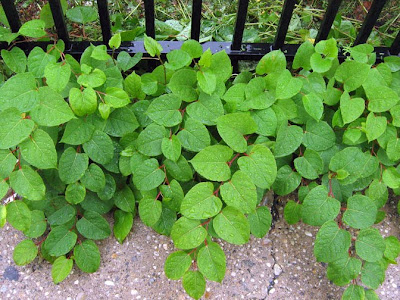
May 4, 2010

Something knotty in your backyard?


Many invasive plants that grow in urban environments are easily removed with a little bit of elbow grease. But Japanese knotweed (Fallopia japonica) is an aggressive weed that can become a huge nightmare for urban gardeners. In heavily infested areas it forms 6-8 foot tall thickets that will displace overgrow garden plants, and it's really hard to get out of your garden.

Japanese knotweed grows from underground root systems called rhizomes. These strong root systems can damage the foundations of buildings and sidewalks. Once a root system establishes, it is difficult to mechanically remove all pieces of the root system so the plant continues to return even as you valiantly try to remove it. If your neighbor on the other side of your fence has an infestation, you will always have Japanese knotweed popping up in your garden because the roots will grow under the fence.

The best way to remove Japanese knotweed from your backyard is to apply a systemic pesticide, such as glyphosate. The pesticide will travel through the whole plant, and will kill the root system.

(Photo from nycgarden.blogspot.com)

April 17, 2010

Is my tree growing a sweater?


If you have an eastern hemlock tree on your property and you live in the Northeast, chances are that you've noticed that it gets woolly at this time of year. Is the tree growing a sweater?

Actually, it's a invasive insect from Asia, the hemlock woolly adelgid, producing egg sacs that have the appearance of wool. The photo above was taken today and shows egg sacs on the underside of a hemlock in Cambridge, MA. These insects suck nutrients from the tree while also injecting a toxin into the tree. After several years of a heavy infection, the tree will die.

If you only have a few hemlocks on your property, you can treat your trees with chemical treatments that kill the adelgid. There are also some more environmentally friendly biological control approaches being developed that use insect enemies of the adelgid to reduce infestations.

April 16, 2010

Sophisticated gardens increase property value

The gardens that create a lush frame around a home are one of the first things that potential buyers notice. A recent article in the Boston Globe points out that attractive landscaping can increase property value by almost 13 percent. This study by Virginia Tech scientists noted that the level of sophistication of the landscaping can raise the value of a home by up to 42 percent. If you are thinking of selling your home, now may be the perfect time to spruce up your garden to attract more potential buyers.

April 10, 2010

Wild Urban Plants of the Northeast

What's that pesky plant that keeps popping up in your beautiful urban garden? Chances are that Peter Del Tredici can help you figure that out in his new book, Wild Urban Plants of the Northeast. Del Tredici is a research scientist at Boston's Arnold Arboretum. This book isn't a "how to kill a weed" book, but is more of a "how can I appreciate this amazingly persistent plant" book. It will likely change how you view the little green monsters poking up through the sidewalks and urban habitats of the South End.

Peter is giving a talk about this book at the Harvard Museum of Natural History, tomorrow, April 11th.

Grow your own urban vegetables

Urban vegetable gardening is becoming increasing popular across North America. South End Gardens can help you design an urban vegetable garden that will provide fresh vegetables throughout the summer, regardless of how much space you have on your roof deck or in your yard.

These French breakfast radishes are already growing in a Shawmut Ave rooftop vegetable garden we built last year. They'll be ready for harvest by the end of April.

April 8, 2010

Plant ID App for your iPhone


Have you noticed a tree or shrub around the city that you'd love to add to your garden, but didn't know it's name? Botany Buddy is a useful app for your iPhone that can help you identify common trees and shrubs on the go.

Alternatively, just take a photo of the plant with your phone and post it on our Facebook Wall. We can figure out what it is and whether it would grow in your garden.